Tingling in Hands and Feet: What's Really Causing It
If it were "just circulation," it wouldn't show up in both hands and both feet. That specific pattern — all four, roughly symmetrical — is your body pointing at something. And the good news buried in it: several of the things it points at are testable, and some are fixable. Let's find out which one is yours.
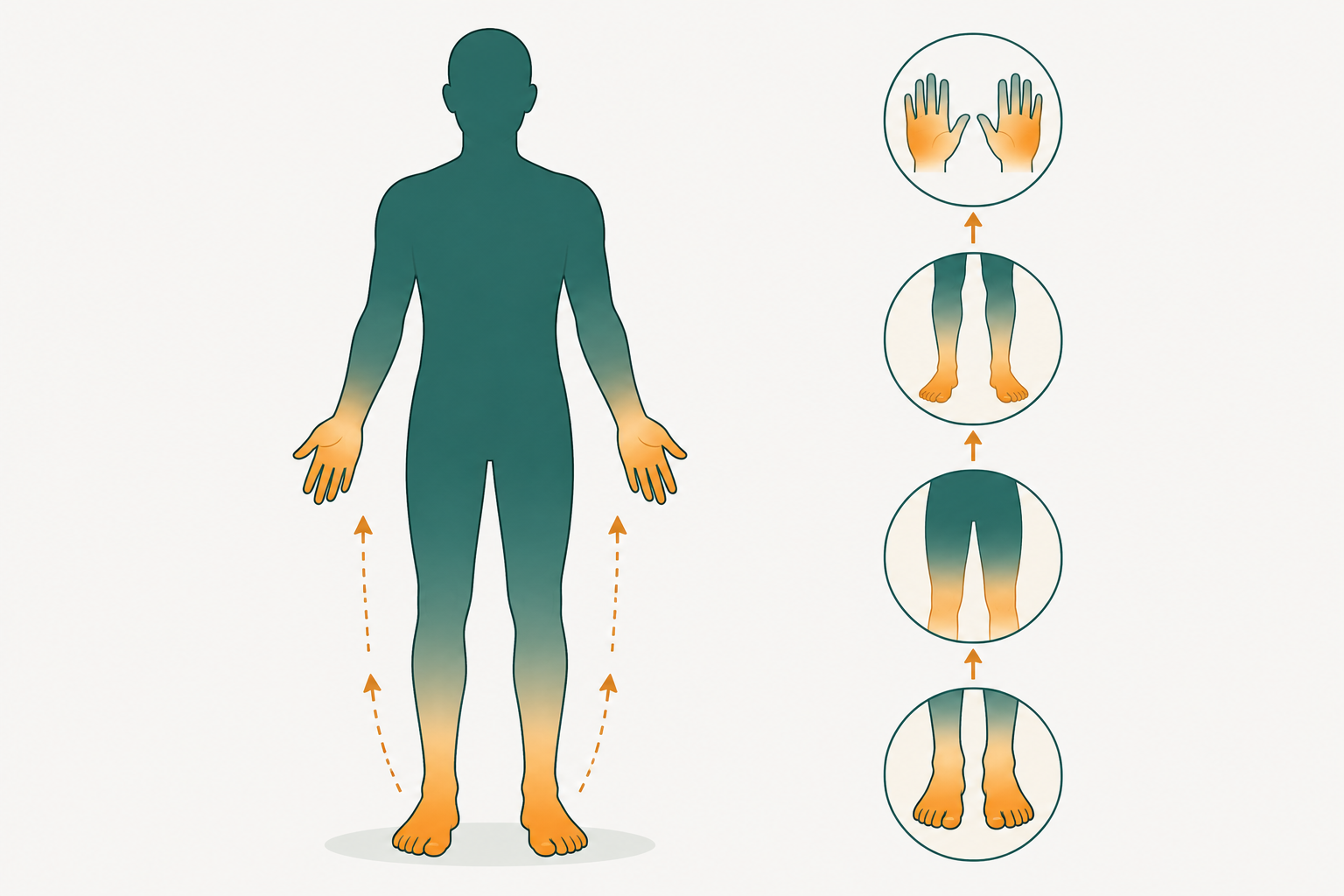
Tingling in both hands and feet is most often a sign of peripheral neuropathy rather than a local pinched nerve. When it's symmetrical across all four limbs, common drivers include diabetes or prediabetes, vitamin B12 deficiency, thyroid problems, and chronic inflammation. The pattern matters: a pinched nerve usually affects one limb, while neuropathy hits the longest nerves first — toes, then fingers.
Most people bring this to a doctor and get told it's circulation, or age, or stress. Here's why that answer should bother you: circulation problems don't usually show up symmetrically in all four limbs. Nerves do. That distinction is the whole reason this page exists.
Why the pattern is the biggest clue you have
Doctors have a name for what you're describing: "glove-and-stocking" distribution — symptoms covering roughly the area a glove and a stocking would.
Why that shape? Because neuropathy comes for the longest nerve fibers first. The longest ones in your body run all the way down to your toes — so feet lead. The next longest reach your fingers — so hands follow, usually later. It's not random. It's anatomy.
And that's why the pattern is diagnostic gold: one hand tingling points toward something local, like carpal tunnel or a pinched nerve. All four, symmetrical points toward something systemic — something in your blood, your nutrition, or your metabolism. Very different investigation.
What's actually behind it
| Cause | Why it tingles | Testable? |
|---|---|---|
| Diabetes / prediabetes | High blood sugar injures the small vessels feeding your nerves | Yes — A1c |
| Vitamin B12 deficiency | Without B12 your body can't maintain the nerve's coating | Yes — blood test |
| Thyroid problems | Metabolic disruption affects nerve function | Yes — thyroid panel |
| Chronic inflammation | Slowly wears down the protective myelin layer | Partly |
| Heavy alcohol use | Toxic to nerves and drains B vitamins | History |
| Pinched nerve / carpal tunnel | Local compression — usually one limb, not four | Yes — exam |
Look at that third column. Most of the systemic causes are measurable with a blood test you can ask for. That's not nothing — that's a path forward, and most people never get offered it.
The B12 lead worth chasing first
If you're over 50, or take metformin or an acid reducer like omeprazole, move B12 to the top of your list. Those drugs quietly drain it, absorption drops with age, and low B12 strips the coating off your nerves — producing exactly this tingling. It's cheap to test and often correctable when caught early. Full breakdown: can a B12 deficiency cause neuropathy?
What the tingling stage is telling you
Here's the timing insight that matters most. Tingling is usually an early symptom — the "too much signal" phase, before things shift toward numbness and loss of sensation. That means you're likely catching this earlier than most people do.
Don't waste that. The drivers behind tingling — blood sugar, B-vitamin status, inflammation — respond best when you go after them early, while there's more healthy nerve left to protect. See exactly where this sits on the timeline: the stages of neuropathy.
What actually helps
- Get the tests — A1c, B12 (with MMA/homocysteine), thyroid
- Address the driver — blood sugar, deficiency correction, alcohol
- Support the nerve — nutrient status and inflammation
- Move — exercise is studied for nerve function and blood sugar together
That last one — supporting the nerve itself — is where a lot of people get stuck, because painkillers don't do it. Researchers have been studying a specific nutrient combination built for exactly that gap.
Want to understand what's actually driving your tingling — and what supports the nerve?
See the nutrient approach researchers are studying for nerve health →When to see a doctor
Bring symmetrical tingling to your doctor and ask specifically about A1c, B12, and thyroid. Get emergency care for sudden tingling or numbness — especially on one side, or with weakness, slurred speech, or facial droop (possible stroke). Also seek prompt care for rapidly spreading symptoms or a non-healing foot wound.
Frequently asked questions
What causes tingling in both hands and feet?
When tingling hits both hands and both feet symmetrically, it usually points to peripheral neuropathy rather than a local pinched nerve. Common drivers are diabetes or prediabetes, vitamin B12 deficiency, thyroid problems, and chronic inflammation. A pinched nerve typically affects one limb, not all four.
Is tingling in hands and feet serious?
It's a signal worth investigating, not usually an emergency. Symmetrical tingling in hands and feet often reflects nerve involvement that's easier to address early. But sudden tingling with weakness, slurred speech, or facial droop needs emergency care.
Can B12 deficiency cause tingling in hands and feet?
Yes — it's one of the classic causes, and one of the few that's directly testable and often correctable. B12 is needed to maintain the protective coating around nerves, and deficiency is common over 50 and in people on metformin or acid reducers.
What is glove-and-stocking tingling?
It's the pattern where symptoms affect the feet and hands in the distribution a glove and a stocking would cover. It happens because neuropathy hits the longest nerves first — the ones running to your toes, then your fingers — and it's a hallmark sign of peripheral neuropathy.
How do you stop tingling in hands and feet?
The real answer is finding and addressing the cause — correcting a B12 deficiency, controlling blood sugar, or managing inflammation. Symptom relief alone doesn't stop the process underneath, which is why identifying the driver matters most.
Sources
- NINDS — Peripheral Neuropathy Fact Sheet (glove-and-stocking pattern)
- NIH Office of Dietary Supplements — Vitamin B12
- Mayo Clinic — Peripheral neuropathy (symptoms and causes)
- ADA / NIDDK — diabetic neuropathy
- American Stroke Association — stroke warning signs (FAST)
This article is for general educational purposes only and is not medical advice. It has not been evaluated by the FDA and is not intended to diagnose, treat, cure, or prevent any disease. Always consult a qualified healthcare provider about your symptoms.