What Causes Neuropathy in the Feet and Legs?
The burning didn't come from nowhere. Something is quietly stripping the protective coating off the nerves in your feet — and almost everything you've been handed only muffles the alarm while the real damage keeps creeping upward. Here's what's actually doing it, why "it's just your age" is a dead end, and how much of this is still in your hands.
Peripheral neuropathy has several well-documented causes — most commonly diabetes and prediabetes, vitamin B12 or B1 deficiency, chemotherapy, heavy alcohol use, and chronic inflammation that wears down the protective myelin coating around nerves. In about 1 in 4 cases (roughly 23%), no single cause is ever found — doctors call this idiopathic. Catching the driver early matters, because nerve damage tends to spread slowly from the toes upward.
Be honest with yourself for a second.
You've felt it building. The tingling that used to visit once a week now shows up every night. The numb patch that's a little bigger than it was last month. The moment you reached for the stair rail without deciding to — your body knew before you did.
And what did you get? A shrug. "It's age." "It's the diabetes." Maybe a prescription that fogs your head and does nothing for the fire in your feet. Here's the question nobody in that rushed appointment stopped to answer: if that were the whole story, why does it keep getting worse no matter what you do?
Because you're being handed a name for the smoke — not the fire. Let me show you the fire.
What actually happens inside a damaged nerve?
Once you see this, every symptom you have is going to make sense. Maybe for the first time.
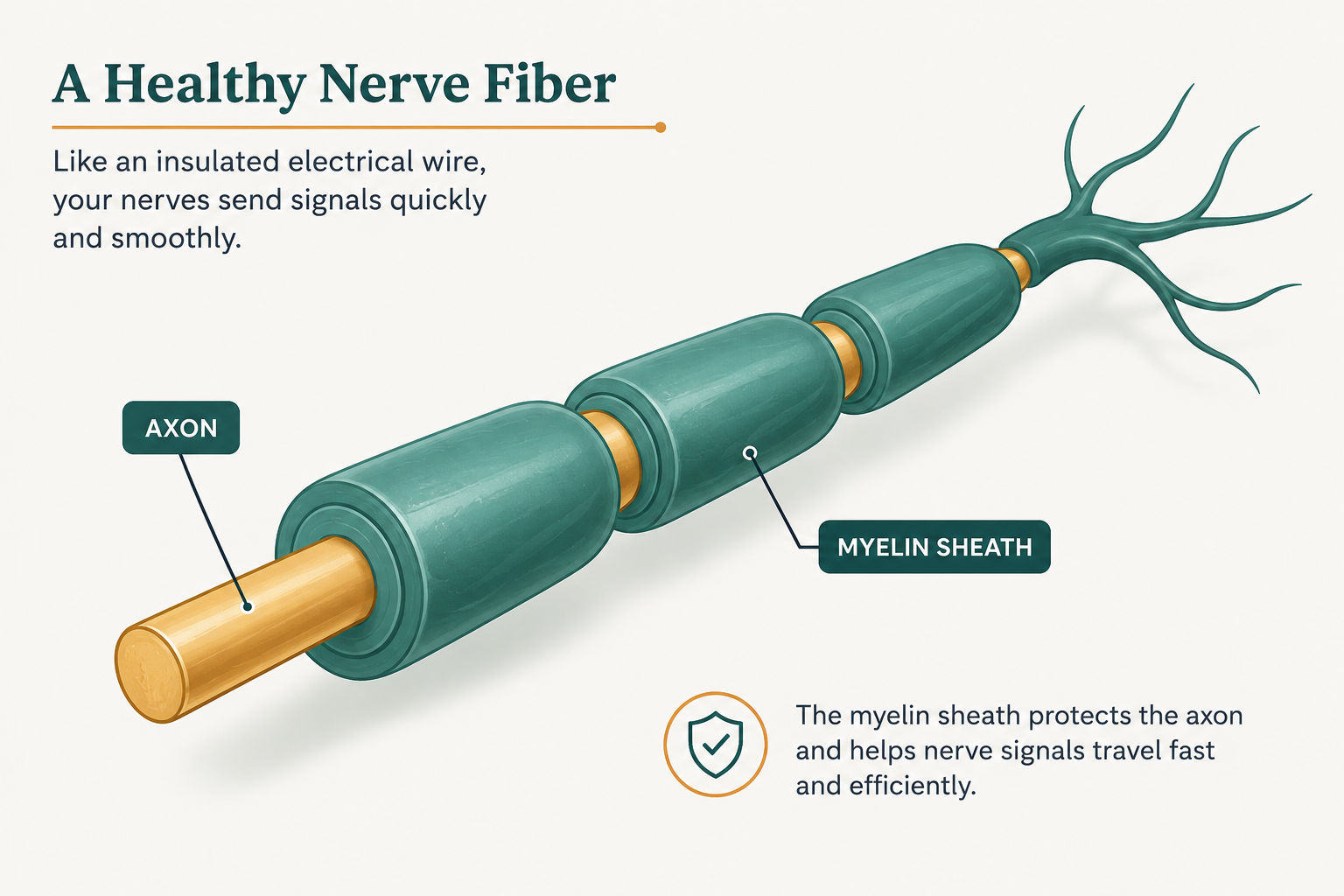
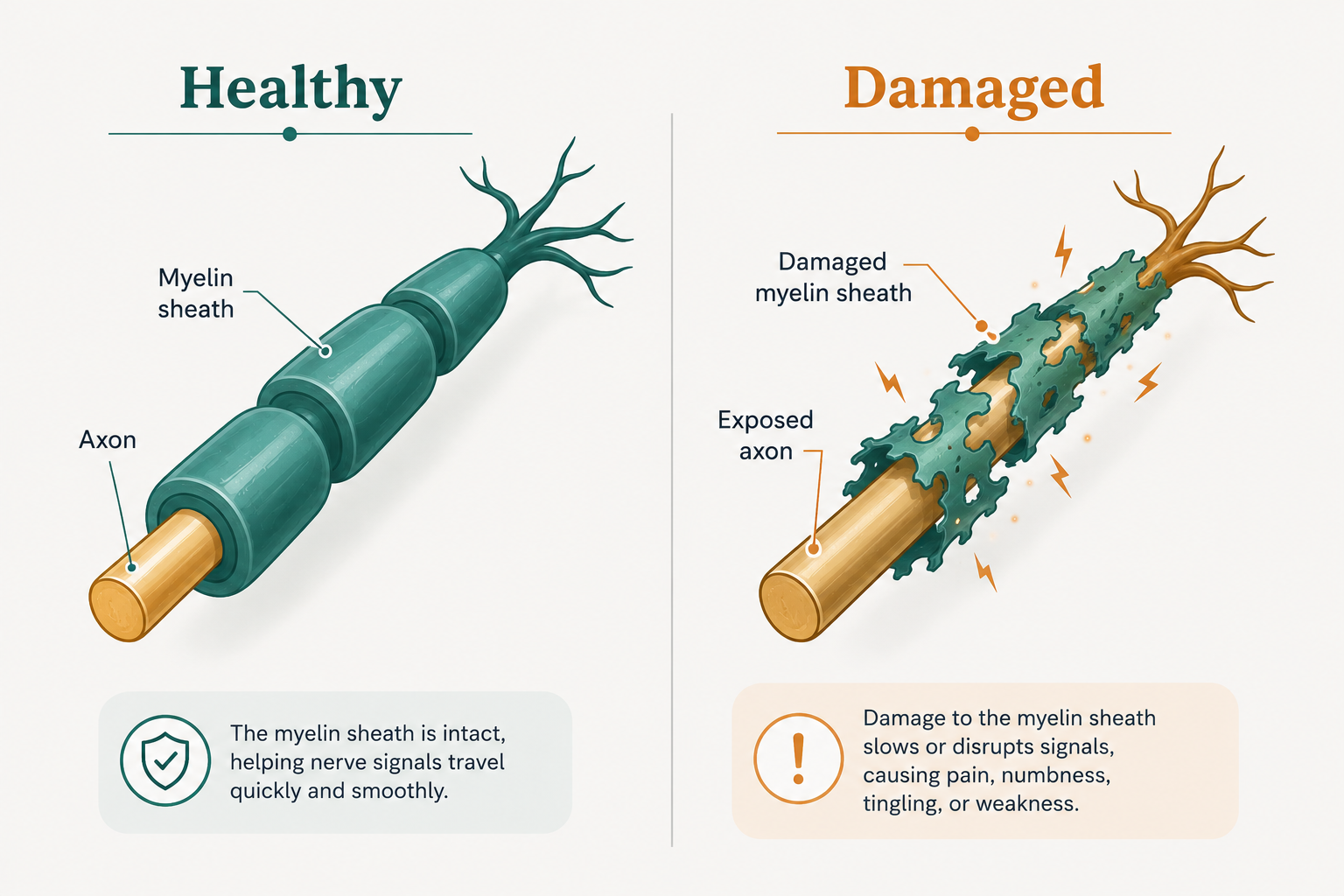
Picture the nerves running down to your toes as electrical wires. Every one of them is wrapped in a protective coating — the same way a lamp cord is wrapped in rubber. Doctors call it the myelin sheath. You can just call it insulation.
When that insulation is intact, the signal runs clean. You feel the floor. You feel your socks. You feel exactly what you should — and nothing you shouldn't.
But strip that coating away, even a little, and the bare wire underneath starts to spark. That spark isn't a metaphor to you. It's the burning that wakes you at 2 a.m. It's the pins-and-needles that won't quit. It's the dead, numb spot that frightens you when you can't feel the gas pedal under your foot.
So here's the only question that matters: what is stripping the coating off your nerves? Get that wrong, and you'll spend years — and a small fortune — arguing with the smoke alarm while the fire keeps burning.
Is neuropathy always caused by diabetes?
Here's the myth that keeps millions of people treating the wrong thing.
Yes — diabetes is the single most common cause, behind roughly 60% of cases, and by the American Diabetes Association's own numbers, half or more of people with diabetes develop some form of neuropathy in their lifetime. That part is real.
But read the next sentence twice, because it changes everything: that still leaves millions of people whose nerves are dying for reasons that have nothing to do with blood sugar. If you've been waved off with "it must be the diabetes" while your glucose sits normal or borderline — you were never given the full picture. And you can't fix a cause nobody bothered to find.
The 7 real causes of peripheral neuropathy
| Cause | How it strips or damages your nerves | Often missed? |
|---|---|---|
| Diabetes / prediabetes | High blood sugar chokes the tiny vessels that feed your nerves | No — but prediabetes slips by constantly |
| Vitamin B12 deficiency | Without B12, your body can't maintain the myelin coating | Yes — shockingly common over 50 |
| Vitamin B1 (thiamine) deficiency | Your nerves run out of the fuel they need to fire | Yes |
| Chemotherapy (CIPN) | Certain drugs are directly toxic to nerve fibers | No — but badly under-supported |
| Heavy alcohol use | Poisons the nerve and strips its nutrients at the same time | Sometimes |
| Chronic inflammation | A slow burn that eats away the nerve's protective layer | Yes — and it's the sneakiest |
| Idiopathic | No cause found — often because no one dug deep enough | By definition |
Each of these gets its own deep-dive (linked below). But almost all of them pull the same thread — and once you see it, you'll understand why the "smoke alarm" treatments keep failing.
How B-vitamin deficiency strips your nerves bare
Three B vitamins do the quiet, thankless work of keeping your nerves insulated: B12, B1 (thiamine), and B9 (folate). They're the raw material your body uses to build and repair myelin. Run low, and the coating starts to thin — no drama, no warning, just a slow unraveling you only notice once the burning starts.
And here's the trap. B12 deficiency is brutally common after 50, because your body simply absorbs less of it with age. Worse: two of the most-prescribed drugs on the planet quietly drain it — metformin (for diabetes) and acid reducers like omeprazole. Sit with that irony. Someone with diabetic neuropathy, dutifully taking metformin, can be fighting two nerve-strippers at once — and never be told.
That last part is the good news buried in the bad: this cause is testable, and catching it early can stop the slide. Which is exactly why it's worth ruling in or out before you accept "there's nothing we can do."

The inflammation connection almost no one explains
Now the sneakiest one of all.
Even when your vitamins look fine, there's a slower fire that can wear your nerves down: chronic inflammation. When your body stays inflamed for months or years, that low, constant burn can keep chipping away at the myelin coating — dragging you right back to the stripped-wire problem.
Let's be straight, because you deserve straight: this is an area researchers are still mapping, so inflammation is a major, partly-controllable factor — not a magic on/off switch. But here's why it should make you sit up: inflammation runs on things you can actually push back on. Nutrition. Blood sugar. And a handful of plant compounds that scientists have been studying hard for their effect on inflamed, irritated nerve tissue.
Why your symptoms start in the feet and creep upward
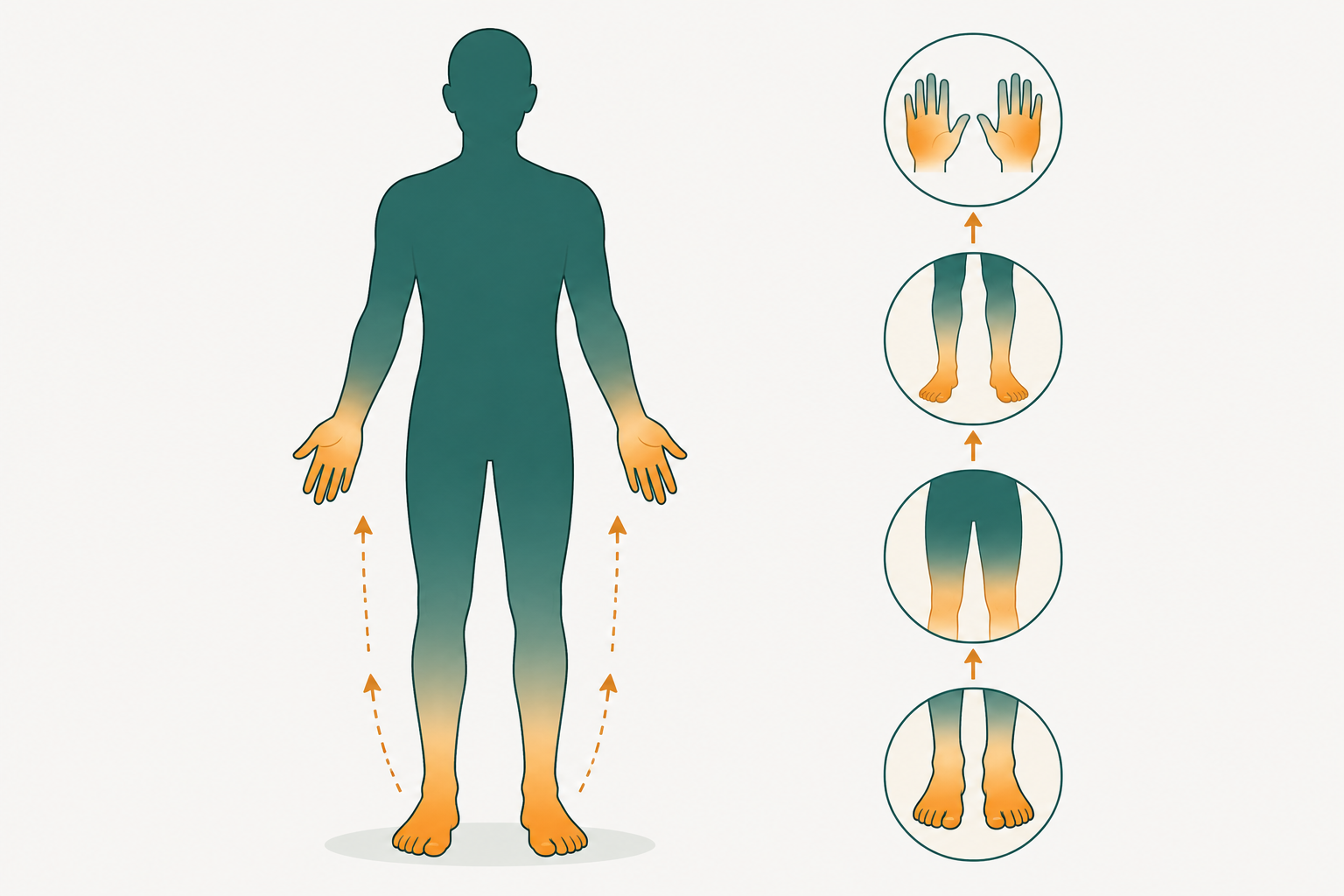
That upward creep isn't random — and it's the one sign you should never wave off.
Neuropathy comes for the longest nerves first — the ones running all the way down to your toes. That's why it almost always opens in the feet, then, over time, reaches for the fingers and hands, and inches up toward the ankles and calves. Doctors call the pattern "stocking-and-glove." You'll call it the map of something that isn't done with you yet.
This is not a reason to panic. It's a reason to move. Symptoms climbing from your toes toward your ankles are telling you the process is active — still going, right now — which is the single strongest argument for finding the cause while there's still healthy nerve left to protect.
How much of this is still in your hands?
More than they let you believe. Let's be honest in both directions.
Some causes are outside your control, and nerve damage that's been grinding on for years may only partly come back. Anyone who promises you a guaranteed overnight miracle is lying to your face — walk away.
But here's the part that should put steel back in your spine: the biggest drivers of this thing — blood sugar, B-vitamin status, and inflammation — are things you can actually move. That means the "why" behind your burning feet is often not a life sentence. It's a lever. And you can pull it.
Now imagine the other side of that lever. A full night's sleep with no fire in your feet. Standing up from a chair without bracing for the jolt. Feeling the floor — the real floor — under your bare feet again. That isn't a fantasy sold by a pill. It starts with one decision: go after the actual cause instead of paying, month after month, to muffle the signal.
That's exactly why so many people are done with symptom-maskers and are looking at approaches aimed at the nerve itself — the nutrient status and inflammation underneath it all. Researchers have been quietly studying one specific nutrient combination for precisely this reason.
If you're ready to stop arguing with the smoke alarm and go after the fire —
See the nutrient approach researchers are studying for nerve health →When to see a doctor (don't skip this)
Most neuropathy builds slowly — but a few situations mean you stop reading and pick up the phone. Get medical care fast if you have:
- Sudden weakness, numbness, or symptoms that explode over hours to days
- Numbness plus a foot wound, sore, or color change that won't heal (especially with diabetes)
- Loss of bladder or bowel control alongside nerve symptoms
- Weakness that's spreading quickly
These are red flags for something that needs a doctor now — this page is about the slow, chronic kind of neuropathy, not a substitute for emergency care.
Frequently asked questions
Can neuropathy be reversed?
Sometimes — and timing is everything. Catch it early and fix the driver (say, a B12 deficiency or runaway blood sugar), and symptoms can improve or stop spreading. Let it grind on for years and you may only claw back part of it. And anyone promising a guaranteed cure is selling you something — there isn't one.
What is the most common cause of neuropathy?
Diabetes, including prediabetes, tops the list. But don't stop there: a huge share of cases trace back to B12 deficiency, chemotherapy, or alcohol — or land in the "no cause found" pile. The most common cause isn't always your cause, which is why a real work-up matters.
Can neuropathy happen without diabetes?
Absolutely. Plenty of people with nerve damage have perfectly normal blood sugar. The usual non-diabetic culprits: vitamin B12 or B1 deficiency, chemotherapy, heavy drinking, autoimmune conditions — or an idiopathic case where no one dug deep enough to name it.
Why are my feet worse at night?
Because at night there's nothing left to distract you from it. The lights go off, your skin cools, the house goes quiet — and the nerve irritation that was humming all day finally has the stage to itself. The damage isn't worse at night. Your attention is.
Which vitamin deficiency causes neuropathy?
B12 is the headline act, but low B1 (thiamine) and B9 (folate) hit your nerves too. B12 especially slips under the radar in anyone over 50 — or on metformin or acid reducers — which is exactly why a simple blood test is worth pushing for.
Sources
- NINDS — Peripheral Neuropathy Fact Sheet (prevalence; symptom progression)
- American Diabetes Association / NIDDK — diabetic neuropathy prevalence
- NIH Office of Dietary Supplements — Vitamin B12 fact sheet
- Mayo Clinic — Peripheral neuropathy (causes overview)
- Foundation for Peripheral Neuropathy — cause breakdown (diabetic ~60%, idiopathic ~23%, chemo ~10%)
This article is for general educational purposes only and is not medical advice. It has not been evaluated by the FDA and is not intended to diagnose, treat, cure, or prevent any disease. Always consult a qualified healthcare provider about your symptoms and before changing any treatment or supplement routine.