Why Is Neuropathy Worse at Night? The Real Reason
You've probably wondered if you're going crazy. All day you cope — then the lights go off and your nerves throw a party. It's not in your head, and there's a real, simple reason for it. Once you understand why the dark makes it worse, you can actually start fighting back and getting some sleep.
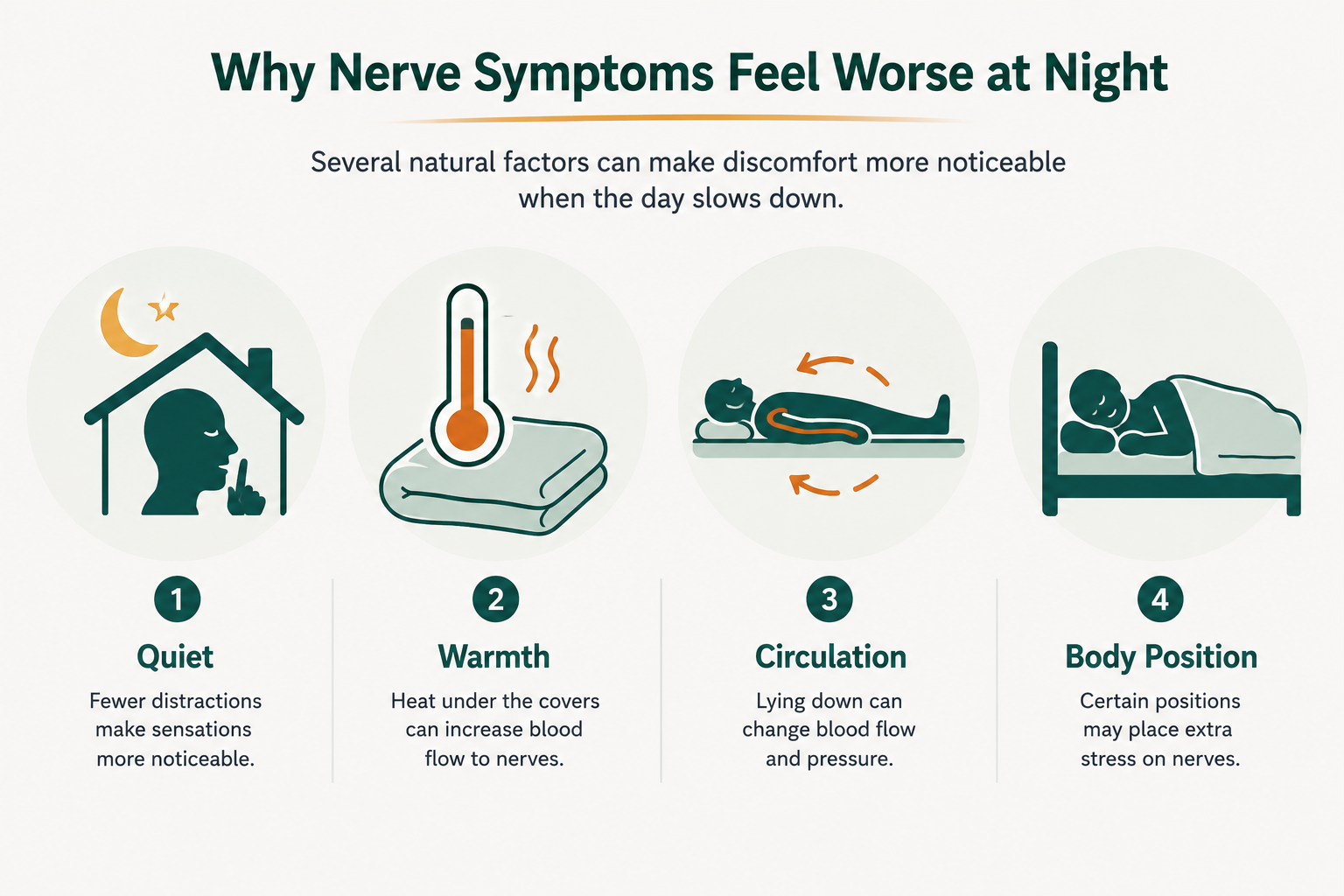
Neuropathy feels worse at night because the daytime distractions that drown it out disappear, your skin and body cool, and lying down changes your circulation — so the same nerve signals feel far more intense. The nerve damage isn't actually worse after dark. Night simply strips away everything that was competing for your attention, leaving you alone with the burning and tingling.
Here's the reassurance you need first: the fire in your feet isn't literally hotter at midnight. Your nerves aren't plotting against you while you sleep. What changes at night isn't the damage — it's the stage. And once you get that, the fixes make sense.
The four reasons the dark betrays you
- Nothing to distract you. All day, work and noise and life shout over the signal. At night the house goes silent — and there's nothing between you and the sensation.
- Your body cools. Evening temperature drops, and heat trapped under blankets can crank burning nerves up.
- Circulation shifts. Lying still moves blood differently than being upright and moving.
- Position. Pressure and posture in bed change how irritated nerves fire.
Add it up and you get the cruel math of neuropathy: the calmer your world gets, the louder your nerves become.
The vicious loop nobody warns you about
Here's what makes night-time nerve pain so brutal: pain wrecks sleep, and bad sleep makes pain feel worse. Round and round. Break the loop at either end — calm the nerves or protect the sleep — and you start to unwind the whole thing. That's why a steady bedtime routine isn't fluff; it's strategy.
What actually helps you get through the night
Practical moves people use to quiet things enough to sleep:
- Keep feet cool and uncovered — let them hang out from under the covers
- Cool (not icy) foot soak before bed
- Loose, breathable bedding and socks
- Slight elevation — a pillow under the calves
- A consistent wind-down to calm your nervous system
Our deeper guides break these down: calming burning feet at night and how to sleep with neuropathy foot pain.
Many people build these into a repeatable before-bed routine — and that consistency matters more than any single trick. There's a specific one people use for exactly this:
Simple enough to try tonight.
When to see a doctor
Night-time nerve pain is usually a feature of ongoing neuropathy, not an emergency — but get prompt care for new, sudden, or rapidly worsening symptoms, or a non-healing foot wound (especially with diabetes). And it's always worth finding the underlying cause: what causes neuropathy.
Frequently asked questions
Why is neuropathy worse at night?
At night the distractions vanish, your skin cools, and lying down shifts circulation — so the same nerve signals feel far louder. The damage isn't worse after dark. Everything that was drowning it out during the day is gone, leaving you alone with it.
How can I stop nerve pain at night?
In the moment: keep feet cool and uncovered, try a comfortably cool soak, use loose bedding, elevate slightly, and run a steady wind-down routine. These ease symptoms — the underlying cause still needs a doctor's attention.
Does neuropathy keep you awake?
For many people, yes — night-time burning and tingling are among the most sleep-wrecking parts of neuropathy. And poor sleep can make pain feel worse, creating a loop worth breaking with a consistent bedtime routine.
Why do my feet burn only at night?
The nerve irritation is present all day, but daytime activity masks it. When you lie down in a quiet, warm bed, there's nothing left to distract you — so the burning takes center stage.
Is nighttime nerve pain a sign of something serious?
It's usually a feature of ongoing neuropathy rather than an emergency. But new, sudden, or rapidly worsening symptoms — or a non-healing foot wound — deserve prompt medical attention.
Sources
- NINDS — Peripheral Neuropathy Fact Sheet
- PubMed — nocturnal exacerbation of neuropathic pain
- PubMed — pain and sleep bidirectional relationship
- Cleveland Clinic — Burning feet syndrome
This article is for general educational purposes only and is not medical advice. It has not been evaluated by the FDA and is not intended to diagnose, treat, cure, or prevent any disease. Always consult a qualified healthcare provider about your symptoms.