Electric Shock Sensations in Legs and Feet: What They Mean
You're sitting still. Doing nothing. And then — a jolt rips down your leg like someone touched a live wire to your skin, and you actually gasp. Nothing caused it. That's the part that unsettles people most. But there is a reason, and it's the same reason behind everything else you're feeling.
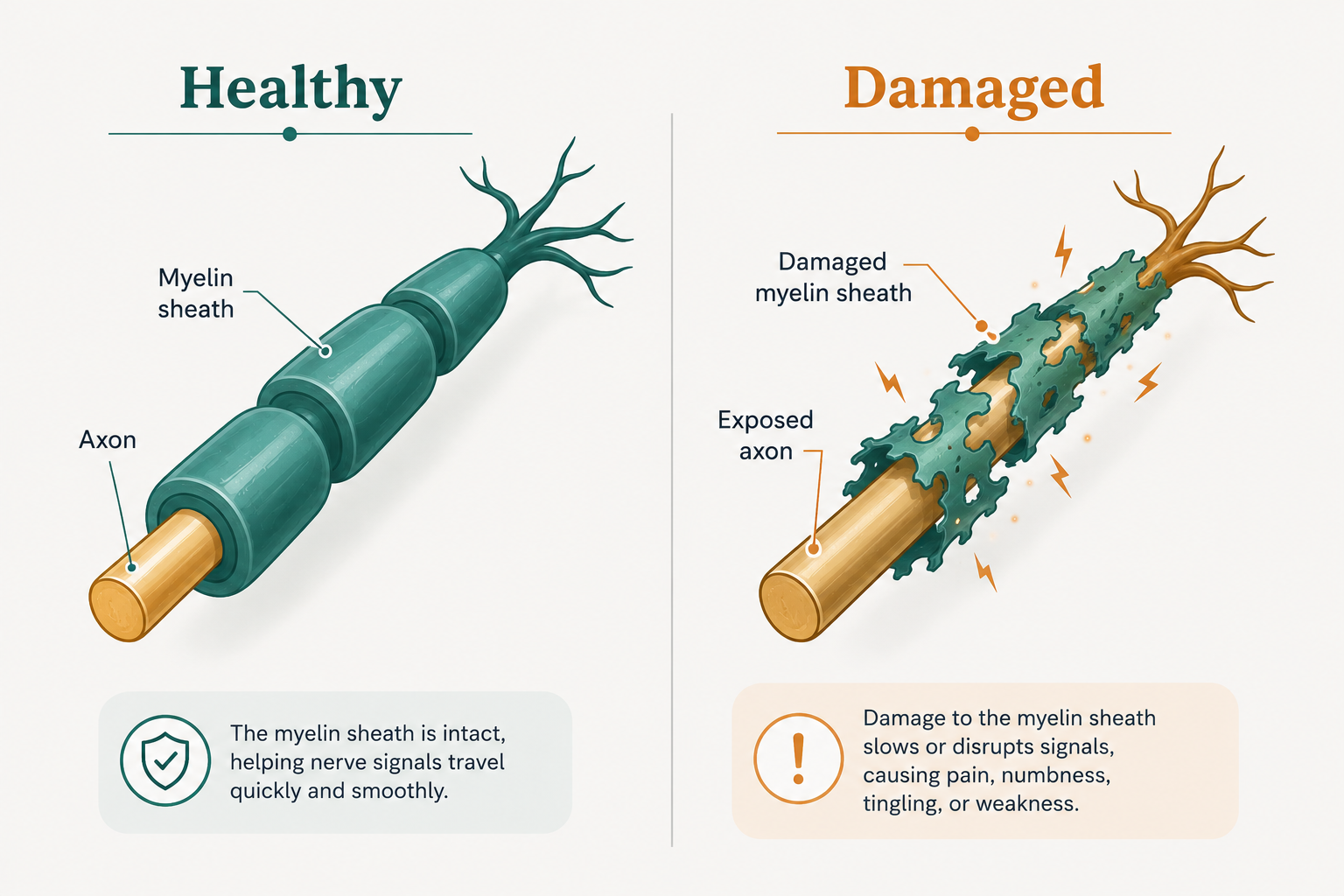
Electric shock sensations in the legs and feet come from damaged nerve fibers firing spontaneously. When the protective myelin coating wears thin, the nerve underneath becomes unstable and discharges on its own — with no outside trigger. You feel that as a sudden jolt. Common drivers include peripheral neuropathy, diabetes, B12 deficiency, and — for shocks running down one leg — sciatica.
Nothing about it makes sense until you understand one thing: these shocks don't need a trigger. You're not doing anything wrong. The signal isn't coming from the outside world at all — it's being generated inside a nerve that's lost its insulation.
Why a damaged nerve fires on its own
Picture the nerve as an electrical wire wrapped in rubber insulation — the myelin sheath. When that coating is intact, the nerve only fires when it's supposed to: you touch something, it sends a signal.
Now strip the insulation. What happens to a bare wire? It sparks. It short-circuits. It throws current where no current should be.
Your nerve does exactly the same thing. Without its coating, the fiber becomes electrically unstable and discharges spontaneously — no stimulus required. That discharge travels the nerve's length and your brain reads it the only way it knows how: as a violent shock in your leg or foot.
So the jolt isn't random. It's a bare wire sparking. Which tells you exactly what to go after.
What's behind the shocks
| Cause | The pattern it usually makes |
|---|---|
| Peripheral neuropathy | Both feet/legs, often with burning and tingling |
| Diabetes / prediabetes | Symmetrical, feet first, worse at night |
| B12 deficiency | Both sides, often with numbness and unsteadiness |
| Sciatica | One leg, shooting from the low back or buttock downward |
| Chronic inflammation | Amplifies whatever else is going on |
That fourth row is worth pausing on. If your shocks run down one leg only, starting in the lower back or buttock, you may be dealing with sciatica rather than peripheral neuropathy — a different problem with a different fix. Check the pattern here: sciatica pain down the leg and foot.
What this symptom tells you about timing
Here's the encouraging read. Electric shocks belong to the "too much signal" phase of neuropathy — the nerve is damaged and irritable, but it's still firing. That's meaningfully different from the later stage where nerves go quiet and you're left with dead numbness.
Translation: shocks are unpleasant, but they usually mean there's still real nerve function in there to protect. See where you land: the stages of neuropathy.
What actually helps
In the moment — options people use when a jolt hits: cool the area, move gently rather than tensing up, and don't brace against it (tension amplifies the next one).
Longer term — and this is the part that matters: the shocks stop being generated when the nerve becomes less irritable. That means going after what's damaging the insulation in the first place:
- Blood sugar, if diabetes or prediabetes is in play
- B12 and B-vitamin status — testable, and the raw material for rebuilding myelin
- Inflammation, which keeps the nerve raw
Painkillers muffle the shock. They don't re-insulate the wire. That's the gap researchers have been studying a specific nutrient combination to address.
Want to go after why the wire is bare instead of just muting the sparks?
Find out how to stop electric shock sensations in your legs and feet. →When to see a doctor
Bring the shocks to your doctor and ask about A1c, B12, and thyroid testing. Get urgent care if shocks come with sudden weakness, loss of bladder or bowel control, or numbness in the groin/inner-thigh (saddle) area — those signal nerve compression needing immediate attention.
Frequently asked questions
What causes electric shock sensations in the legs and feet?
They come from damaged nerve fibers firing on their own. When the protective myelin coating wears thin, the nerve underneath becomes unstable and discharges spontaneously — you feel that as a sudden jolt. Common drivers include peripheral neuropathy, diabetes, B12 deficiency, and in the leg specifically, sciatica.
Why do the shocks come out of nowhere?
Because they aren't triggered by anything outside you. An irritated, poorly insulated nerve fires spontaneously — no stimulus required. That's why the jolts feel random and can hit while you're sitting perfectly still.
Are electric shock sensations dangerous?
The sensation itself isn't harmful, but it signals nerve irritation worth investigating. Get urgent care if shocks come with sudden weakness, loss of bladder or bowel control, or saddle-area numbness — those point to something needing immediate attention.
How do you stop nerve shocks in the legs?
Short term, some people get relief from cooling, gentle movement, and calming the nervous system. Longer term, the real answer is addressing what's damaging the nerve — blood sugar, B12 status, inflammation — since that's what makes the nerve unstable in the first place.
Are electric shocks a sign neuropathy is getting worse?
Not necessarily worse — but they do mean the nerve is actively irritated. Shocks tend to belong to the "too much signal" phase rather than the later numbness phase, which often means there's still meaningful nerve function to protect.
Sources
- NINDS — Peripheral Neuropathy Fact Sheet (neuropathic pain, spontaneous firing)
- Mayo Clinic — Peripheral neuropathy (symptoms)
- NIH Office of Dietary Supplements — Vitamin B12
- Mayo Clinic — Sciatica (red flags)
This article is for general educational purposes only and is not medical advice. It has not been evaluated by the FDA and is not intended to diagnose, treat, cure, or prevent any disease. Always consult a qualified healthcare provider about your symptoms.